 ← Articles
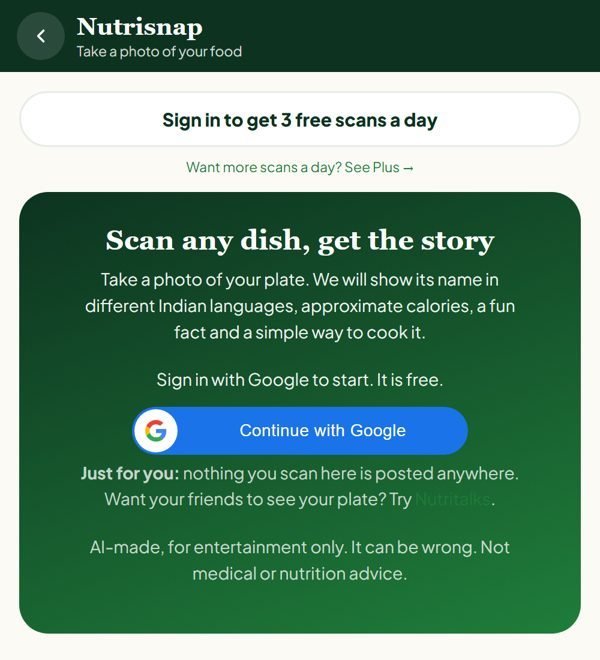
Most calorie apps make you search for every item and guess the serving. With Nutrisnap you take one photo of your plate, and it tells you what the dish probably is and an approximate calorie range for the portion it sees. It is built for Indian food: poha, dosa, rajma chawal, thali, chaat and the rest.
Better photos, better guesses: shoot in daylight, from straight above, with the whole plate in the frame. A spoon or roti next to the food helps the AI judge the size.
| Plan | Scans a day | Price |
|---|---|---|
| Free | 3 scans | ₹0 |
| NutritionSimplify Plus | 10 scans | ₹99 / 30 days |
Limits as shown on the site today; they may change.
Treat it as a ballpark, not a measurement. A photo cannot see how much oil or ghee went into the tadka, how thick the dal is, or what is hidden under the rice, and those change the number a lot. That is why Nutrisnap gives a range. Use it to get a feel for your plate, and use the calorie tables in our articles when you want to add things up part by part.
Nutrisnap is for fun and general information only. It is an AI guess, it can be wrong, and it is not medical or nutrition advice. If you have a calorie target from a doctor or dietitian, follow that.
Nutrisnap is private: nothing you scan is posted anywhere. If you would like friends or family to see what you are eating, use Nutritalks, where you post your plate to a group.
Yes, approximately. Nutrisnap looks at the photo, names the dish and gives an approximate calorie range for the portion it sees. It is an estimate, not an exact count.
Yes. It is built for Indian dishes such as dosa, idli, poha, biryani, rajma chawal, thalis and street food, and shows dish names in several Indian languages.
Yes. You get 3 free scans a day after signing in with Google. NutritionSimplify Plus gives 10 scans a day for ₹99 for 30 days.
No. Nutrisnap results are only for you. Posting a plate for others to see happens only in Nutritalks, and only if you choose to.
One photo, an approximate calorie range. An AI guess, just for fun.
Scan your food Open Nutritalks